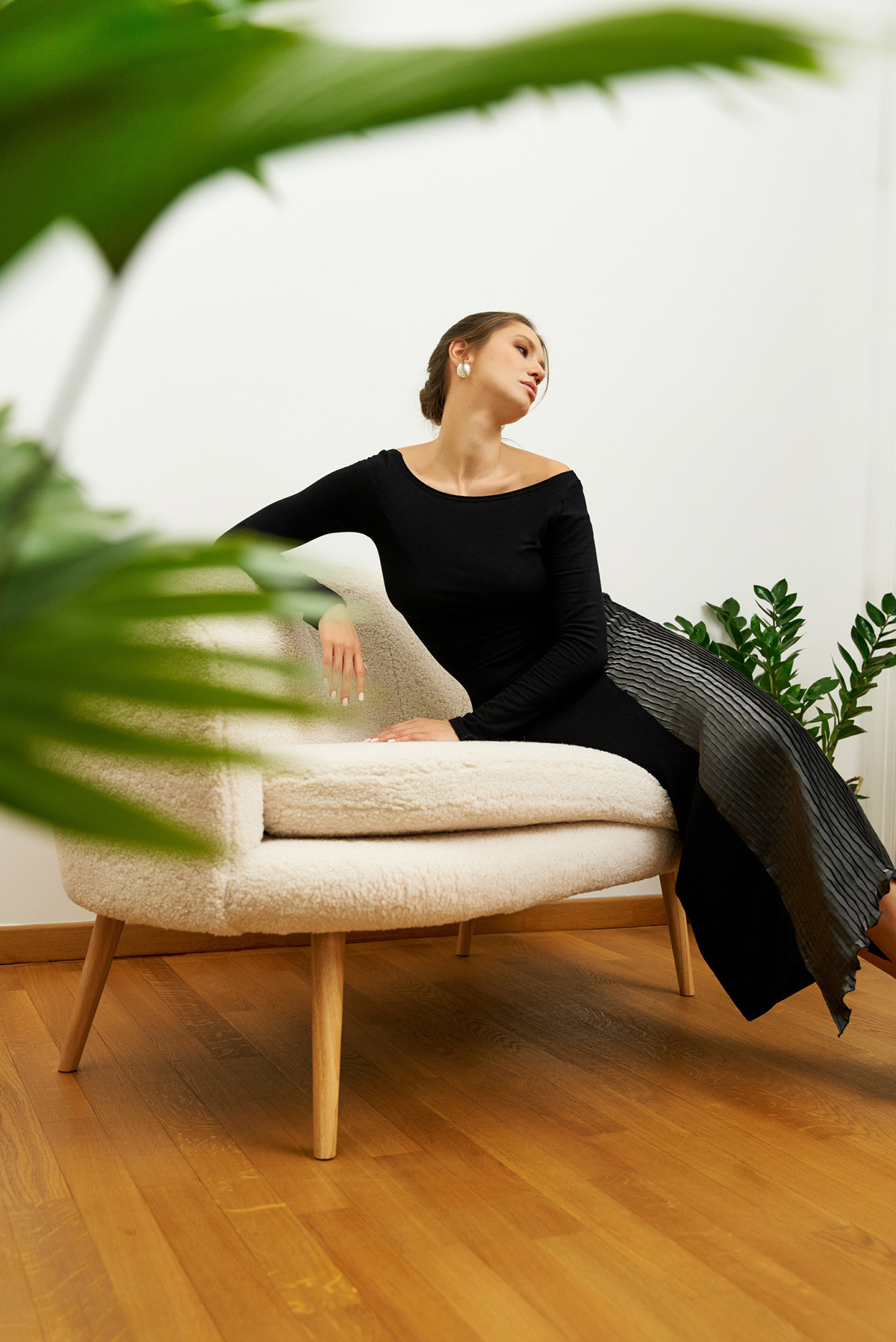
EVERY DALB WOMAN HAS A UNIQUE STORY TO TELL
SUCCESS, CHALLENGES AND STYLE FROM REMARKABLE WOMEN
There is a discipline of beauty that mirrors the discipline of peak performance. Ana Maria Brânză, multiple Olympic, World, and European champion in fencing, showed us on the piste what a strong mind truly looks like. Beyond competition, she inspires through the way she carries her femininity — with clarity, intention, and quiet power.
Ana Maria Brânză embodies the duality we celebrate at DALB — Powerful minds in delicate frames: where strength of character meets the fragility of form.
We first met in 2019, through the Autentica by Ana-Maria Brânză project — an initiative dedicated to supporting Romania’s creative voices. DALB was honored to be part of that moment. What began as a collaboration became a conversation about values, craftsmanship, and the many ways femininity can be expressed with substance.
In this edition of DALB Women Talks, we reflect on the transition from the fencer’s armor to the everyday armor of meaningful clothing. We revisit the competitive years — the discipline, the sacrifices, the invisible battles — and explore how those chapters continue to shape the woman she is today.
This is a conversation about the inner architecture of a champion — beyond medals and statistics — and about the grace of building a life with intention.
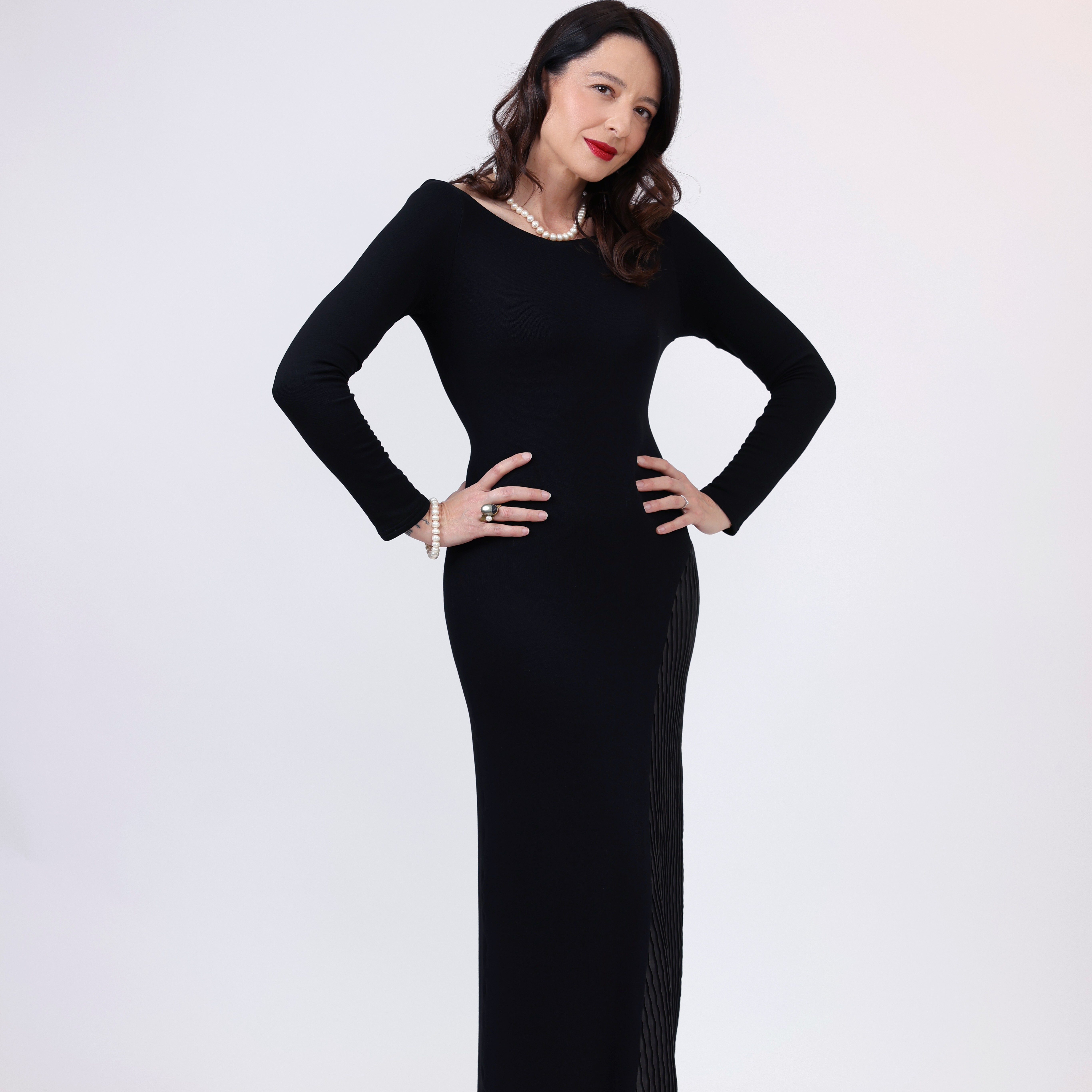
“Everyday life taught me that true power also lies in delicacy, empathy, and attention to those around me”
Your career was defined by rigorous discipline and a mind that doesn’t accept half-measures. How do you now translate that “iron strength” into a warm and delicate presence in everyday life? Is this duality a conscious choice?
I believe this duality isn’t something I created intentionally, but rather something that came naturally because of my journey. That strength helped me get through difficult moments and reach performances I only dared to dream of as a child, but everyday life taught me that true power also lies in delicacy, empathy, and attention to those around me. I try to show the same discipline in subtler ways — through patience, active listening, and small gestures that matter. Somehow that toughness softened after I retired from sports — not by choice, and I have only become aware of this only because others pointed it out. It was even amusing to hear comments like “you’re a different person now, before you were always in a fight mode.”
During your competitive years you reached the highest levels, with Olympic, World, and European medals. What were the biggest challenges of that period, and what did you learn about resilience, discipline, and handling such high pressure? When did you realize that resilience means not just enduring, but evolving?
The biggest challenges were the injuries and the moments when my body or mind said “I can’t anymore, it’s hard, it hurts,” and I had to find the strength to keep going. I learned that resilience isn’t just staying afloat but turning every failure into an opportunity to grow. Sport taught me that a champion isn’t only the athlete who stands on the top step of the podium, but anyone who gets up after failure, reinvents themselves, learns their lessons, and starts again on the path to performance. That realization came after a difficult competition, when I missed an important objective at the London 2012 Olympics. Instead of shutting down in frustration, I began to look closely at what I could learn from this experience and adjust what wasn’t working. True resilience means keeping your essence, but becoming better, clearer, and more prepared for the next step.
“(...) resilience isn’t just staying afloat but turning every failure into an opportunity to grow”
In sports, success is built over years of quiet work, just as in slow fashion value comes from attention to detail. How do you see the relationship between patience and quality in a world that wants everything “instantly”?
From patience comes the value. For years my coaches repeated obsessively “patience is the weapon of the épée fencer,” and it took me a while to understand this, since épée is a tactical event. In sports, every training session, every small correction, every adjustment matters. The same goes for anything truly well made — whether slow fashion, writing, dance, or any passion — quality comes from attention to detail and perseverance. The world pushes us to rush, but true satisfaction comes when you see the results of your work after consistent time and effort. Sport taught me that performance takes time… all the time — and that translates into patience.
What would you tell young women who want to turn their passion into a successful career — in sports or any other field?
I would encourage them to believe in themselves, in their dream, to be patient and accept that the road is never straight or easy. To invest every day, even when results aren’t visible yet. To treat failures as lessons, not obstacles, and never lose the joy of what they do. Success doesn’t come only from talent, but from perseverance, discipline, and authenticity.
What is your “touch” of resilience in vulnerable moments? What choices help you regain clarity when life becomes too fast?
My “touch” of resilience is returning to simple things that reconnect me with myself: a walk, a few deep breaths, writing, or conversations with my loved ones. I choose to slow down consciously, reflect, and ask myself: what is essential, what can I let go of? Clarity comes when I allow myself to feel without judgment and choose actions that nourish my energy and inner balance. A lesson I learned perhaps a bit late, after retiring from sport, is to give myself time — and I share this gladly because I see adults around me who, in the rush of life, forget two things: that play is essential, and that the time you don’t give yourself when you need it is lost, and there’s no point mourning it later.
“A lesson I learned perhaps a bit late, after retiring from sport, is to give myself time”
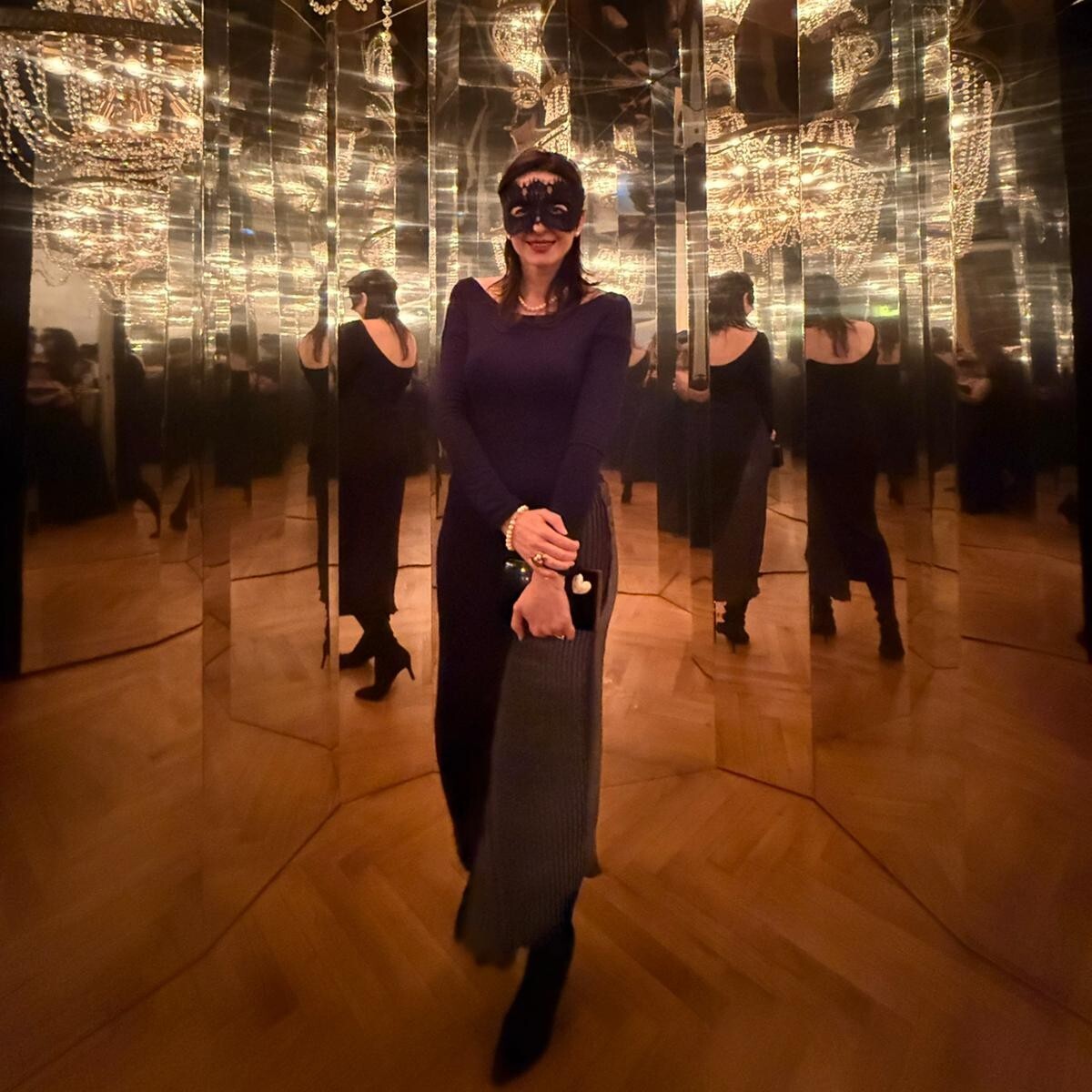
Wherever life takes me, I will remain a promoter and storyteller of Romanian creators.
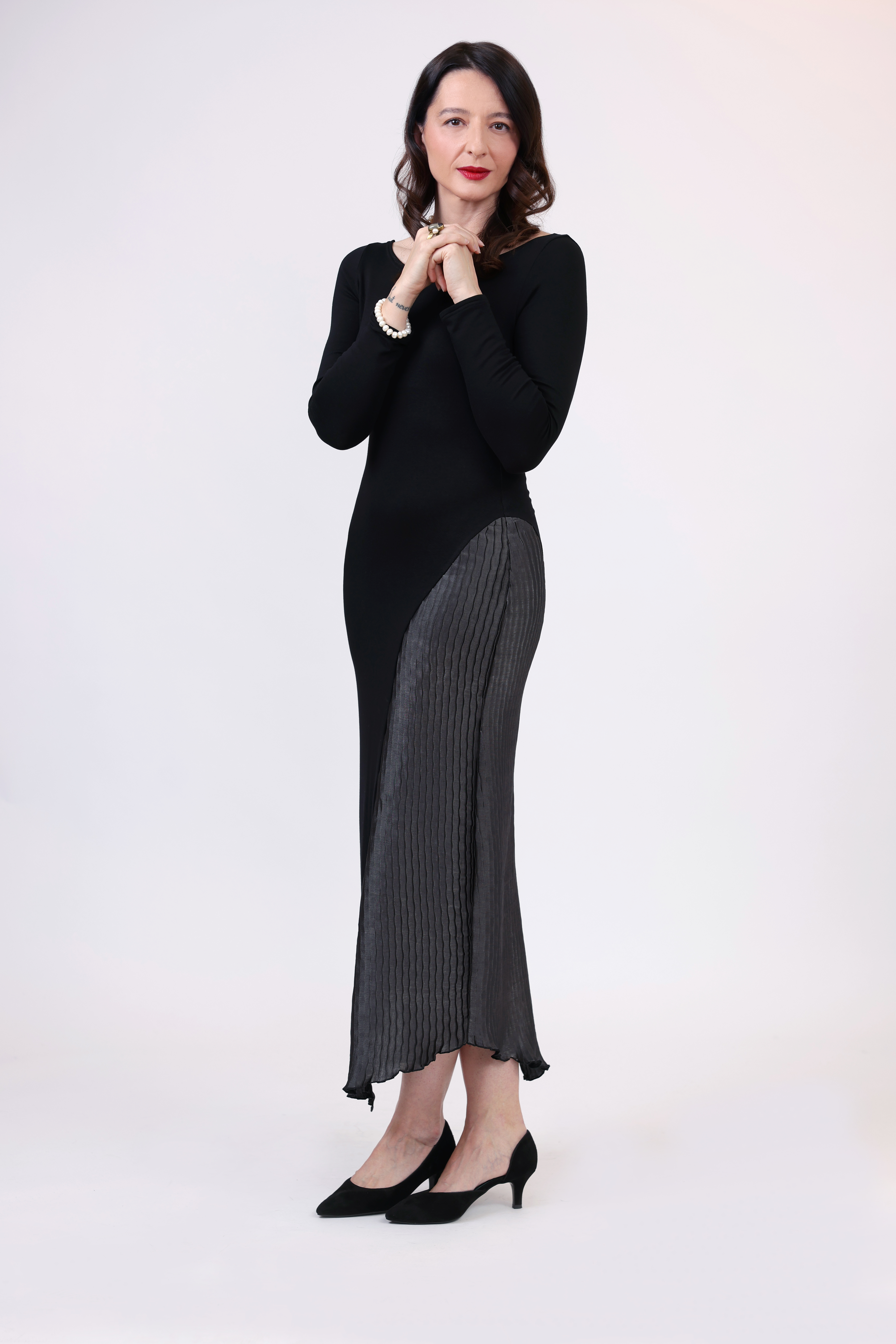
For years, your “work uniform” was technical, white, and rigid. How has your relationship with everyday clothing changed since leaving the piste?
After years in which everything had to be white, crisp, and without exception, I discovered the joy of wearing clothes that reflect me and make me feel free. Now I choose with my heart, not strict rules. Each piece is a small statement about me, about my mood, and the pressure of technical perfection is gone. Everyday clothing has become my way of expressing delicacy, comfort, and authenticity — and quite often, a touch of playfulness. Some days I feel like wearing a dress and heels, other days a hoodie and jeans make me happy — and I choose to honor that whenever the situation allows.
We believe a well crafted piece can change how we feel. Do you choose textures or garments that give you more confidence or relaxation when you need an external boost?
Absolutely. The texture of a material, how a cut falls, or how easily it follows my movements can change my mood instantly. In moments of need, I choose pieces that make me feel “safe” with myself or give me a boost of confidence. It’s my way of carrying positive energy without saying a word — clothes become a subtle but powerful ally.
After so many Olympic finals where every millimeter mattered, how do you relate now to the details of a garment? Do you look for the same precision in tailoring that you once sought in the tip of your épée? What do you look for when choosing a piece — structure, material, or the story behind it?
My eye for detail hasn’t disappeared; it simply moved from the piste to the wardrobe. I look for harmony between structure and material, but above all I look for stories. A well tailored piece gives me a feeling similar to a successful training session: balance, precision, and elegance. The story behind a garment matters as much as the texture or cut — it’s what makes it memorable and relevant to me, because I understand the process behind it. I “see” the work, the struggle, the creative process, the emotion — everything I wished people could see behind the shiny medals.
“For me, those details — whether a delicate seam or a surprising cut — reflect exactly how I live my femininity: with subtlety, but with a strong presence.”
We met through the Autentica project, and recently you explored our pieces again. Is there a detail — a piece, a material, or a design structure — that resonated with how you see yourself as a woman?
What truly touched me when we met for the Autentica project was the delicacy of the pieces — those elegant dresses, seemingly fragile but full of attitude — or the red linen dress I wore with great joy for many summers. I was especially drawn to pieces where the texture feels almost like an extension of the skin, conveying the feeling of being at peace with who you are. For me, those details — whether a delicate seam or a surprising cut — reflect exactly how I live my femininity: with subtlety, but with a strong presence.
Looking back at our 2019 meeting, how do you feel Romanian design has evolved, and how important is the “Made in Romania” label to you today?
Since 2019, I believe Romanian design has matured, but it also has a unique dynamic: ateliers closing their doors, but also new designers finding the courage to enter this crowded and colorful market. I’ve seen a shift from decorative tendencies to more sophisticated approaches, with stories and concepts that speak directly to the wearer. For me, the “Made in Romania” label is a symbol of responsibility and authenticity, and it remains important because it carries the value of local work, creativity, and respect for materials and people. I could say I “hunt” such pieces — and my latest success is that even my ski suit says “Made in Romania.” Wherever life takes me, I will remain a promoter and storyteller of Romanian creators.
For a woman who has won everything there is to win in sports, what does it mean today to truly be “in your own skin”? Does confidence come from external validation or from the quality of your own choices?
Being “in your own skin” means feeling at home in your own life, with all the choices you make. Confidence no longer comes from medals or external praise, but from knowing that your decisions reflect who you truly are and what matters to you. It’s a balance between taking responsibility for your choices and accepting vulnerability — which, paradoxically, makes you stronger. I can say clearly that right now I am well in my own skin — and this isn’t a given, it begins with self knowledge and acceptance.
If your life were a fabric (silk, wool, organic cotton), which would it be and what would it say about the stage you’re in?
I think my life would be natural silk: soft, fluid, with subtle shines that change depending on the light. It’s a material that requires care but offers elegance and comfort. At this stage of my life, it reflects the balance between sensitivity and strength, between fragility and resilience, and the joy of living authentically, without unnecessary artifices. Although, thinking more, I believe I’m a “fabric” with many contrasting threads that sometimes get tangled — but I choose to believe that’s the joy of life. Not to be perfect, but to be present.
© DALB 2026 | Photo credit: Adi Stoicoviciu
Ana’s pick
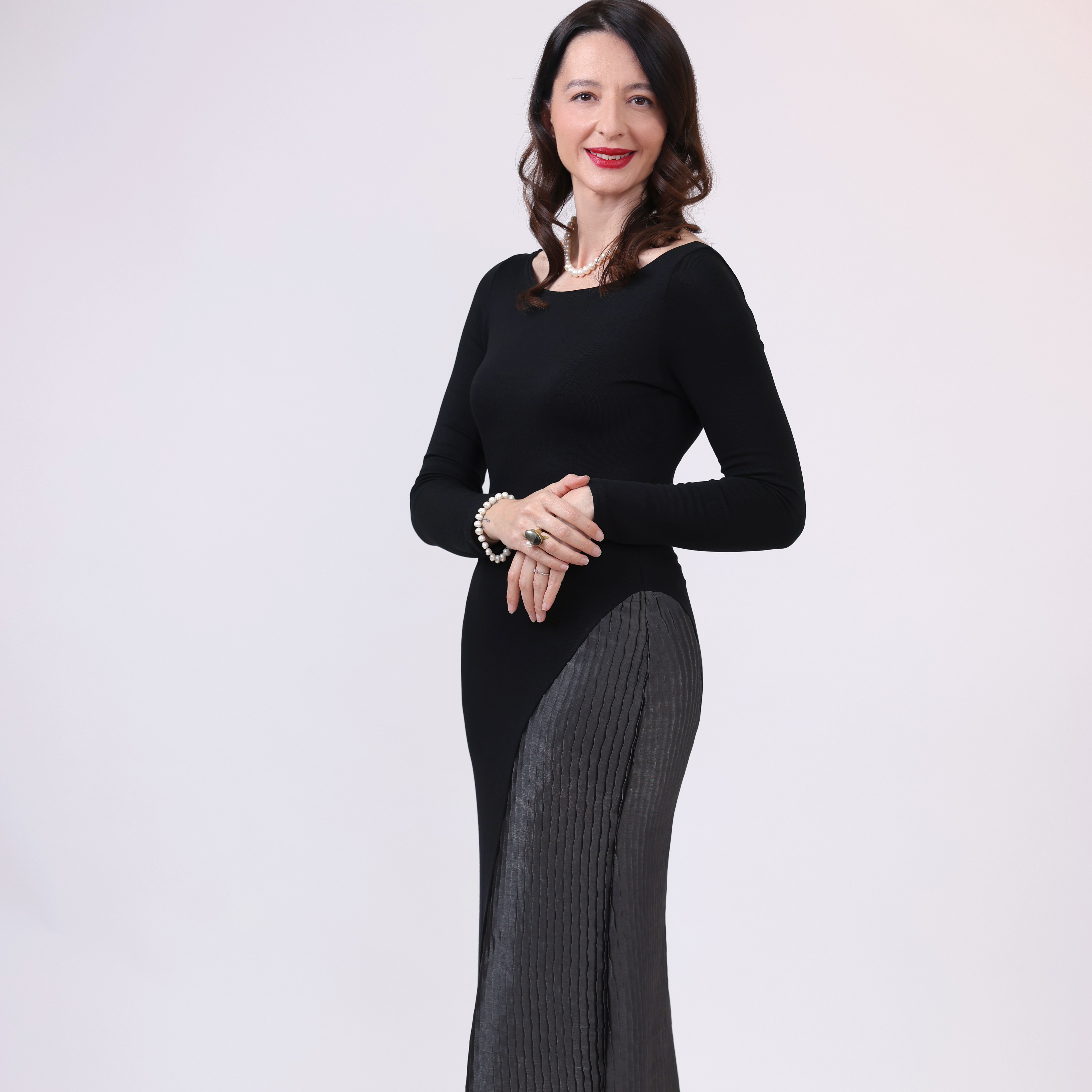
For moments when strength meets softness, Ana chose this dress — a timeless silhouette that moves with intention.